
On 7 July, I packed my bags again to head for conference, this time to the beautiful venue of St Andrews
I chose the wonderful Caledonian Sleeper as a stress free ride up to Edinburgh, arriving refreshed on Monday morning in good time for the conference kickoff.

The train journey from Edinburgh to Leuchars is stunning, with myriad coastal views looking particularly impressive in the sunshine (less so on the way back when it was raining, but still with its own grandeur).

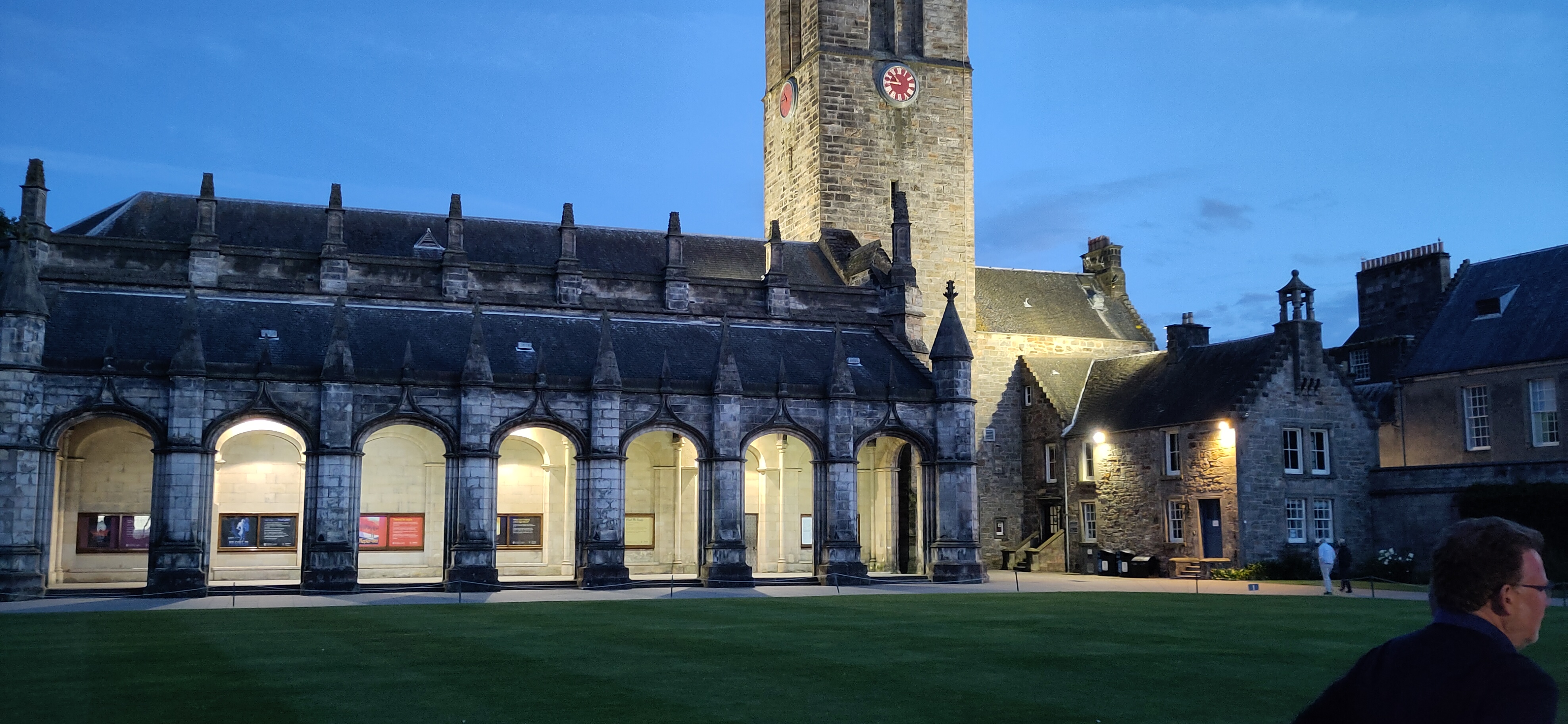
St Andrews doesn’t actually have a train station, but the bus service from Leuchars is frequent, quick and reliable. The conference venue, Youngers Hall, is about 10 minutes walk from the bus station, allowing me to familiarise myself with the town, which is very picturesque and historic and conveniently small (like Cambridge – or maybe Durham – in miniature). I got a coffee from ‘Taste’ which bears a plaque stating that this was the place that ‘Kate dumped Will’ (another thing ‘The Crown’ got wrong?). On the second day, I went for an early morning run on ‘West Sands’ (the place where ‘Chariots of Fire’ was apparently filmed – I can confidently state that my pace was some way off the fabled 4 minute mile).

But I am getting ahead of myself. In any case, I wasn’t just there to sightsee. ESLTIS is a conference specifically for teaching focussed academics, and (importantly) those who are supporting and leading educational change, like learning support teams and academic developers. Like most conferences, there were parallel streams, so what follows is a very partial account of what I saw and what resonated most with me.
The conference started with a keynote from Clare Peddie (VP Education at St Andrews). She described the journey at St Andrews to give teaching focussed academics a defined career path (I noted considerable similarities with what has happened at Bath). At the end of the conference, Sam Nolan (Director of Durham University’s Centre for Academic Development) took up that theme and added further insights. Some points I took from both of them:
- We have come a long way – in 1991, there was no mention of pedagogy in the national conference of university professors.
- Now there are a significant number of academics promoted on the learning and teaching route (in St Andrews, Durham, Bath and doubtless many other institutions).
- However this hasn’t lead to as much gender balancing in the higher level roles as Clare was hoping.
- Once interesting idea (from Sam) is to oblige staff to apply for promotion on a bi-annual basis (tied into the annual appraisal). This has made a big difference in the more balanced representation of those that get promoted (countering the tendency that the demographics of those who apply for promotion is non-representative).
- Other developments include CPD/PGCAPP (presumably including support for HEA accreditation and NTF), education development leave, and mentoring.
- Both Sam and Clare stressed the importance of mentors (which also echoes my own experience, as well as advice I have heard elsewhere). There was some discussion on mentors vs coaches, and the importance of listening, and context specific advice.
- I was delighted to learn that we are planning to set up a mentoring network within ELSTIS.
- Context informs action, and context defines impact. Context can also constrain the scope of change – but Sam pointed out that scope is somewhat elastic.
I noticed just about in time that there was a workshop on New Model Institute for Technology & Engineering (NMITE) from Gary Wood and Bertie Knight. As part of my work with the new Centre for Excellence in Engineering & Design Education (CEEDE) at Bath, NMITE is very much on my agenda as a model to explore. NMITE is a new ‘challenger’ university offering a distinctive engineering education. Some key differences from traditional universities include: no requirements for Maths/Physics A level; integrated engineering (ie rather than discipline specific eg mechanical/electrical); students ‘own’ their own space for the whole of a module (8 weeks); no lectures (studio based education) – and very team based; no exams; accelerated (3 years rather than 4 – shorter summer holidays). I liked the idea of free team breakfasts (for the students) which built team camaraderie and dynamics. I had a good chat with Gary afterwards covering various other aspects of NMITE and comparing it to other institutions like Dyson, The Engineering and Design Institute (TEDi) and The London Interdisciplinary School (LIS).
Other themes explored from a variety of interesting talks including
- Intrinsic motivation (Anna Smith from St Andrews gave a good talk on this). Are we harming students learning through an over focus on grading? Anna made a good point that maybe we need to be clearer on exactly what we want to assess. Alessio Iannetti noted that optional module choice was sometimes driven by genuine interest but sometimes (typically later in the degree) by explicit factors like perceived difficulty. Nobody explicitly mentioned growth mindset, but it was strongly hinted at. Also no one mentioned ungrading, which I was a bit surprised at. Perhaps I missed it.
- Group teaching. I perceived a general trend to have longer lasting teams which is consonant with the Team Based Learning principle of ‘permanent’ teams allowing the full team development lifecycle.
- Lots of active learning examples, including for example changing dry ‘research methods’ courses to project based learning, with interdisciplinary teams. Liwei Guo and Mary Abed Al Ahad both had valuable practice to share.
- Quite a lot of work on impact, including Simmons use of the 4M framework (micro, meso, macro and mega) impact. This is linked, sometime explicitly, to career progression pathways.
- Also a focus on ‘change is the only constant’ – as Heraclitus noted a little while ago.
- One interesting stat from the OU. Over the last decade (if I scribbled this down correctly) we have increased student numbers by 400K and academic staff numbers by 20K (as a sector). While this has increased staff student ratio slightly (from around 12:1 to around 13:1 if my maths is right), what is interesting to me is that the net rise in staff numbers is apparently almost entirely down to teaching focussed staff.
- Some discussion on the politics on internationalisation. Given that many Universities are financially dependent on international student recruitment, there is attention paid to the risk of this ‘pipeline’ drying up. Robbie Watt pointed out that the language used around this is often discriminatory, and we had a good discussion on the student experience of international students – tying into the recurring theme of listening to (and partnering with) students.
- A few talks (unsurprisingly) on generative AI (genAI), and how people are using this. It reinforces my view that we need to help students to use genAI effectively. One idea I am planning next year is to get students to use AI with a topic they are already expert in (eg Manchester United, Taylor Swift, the MCU and probably numerous other more topical references). That way students can see where the output of genAI is both useful but also sometimes incomplete, shallow, misleading or just wrong. Alessio Iannetti had a similar approach, using a diabetes scenario that his students were familiar with.
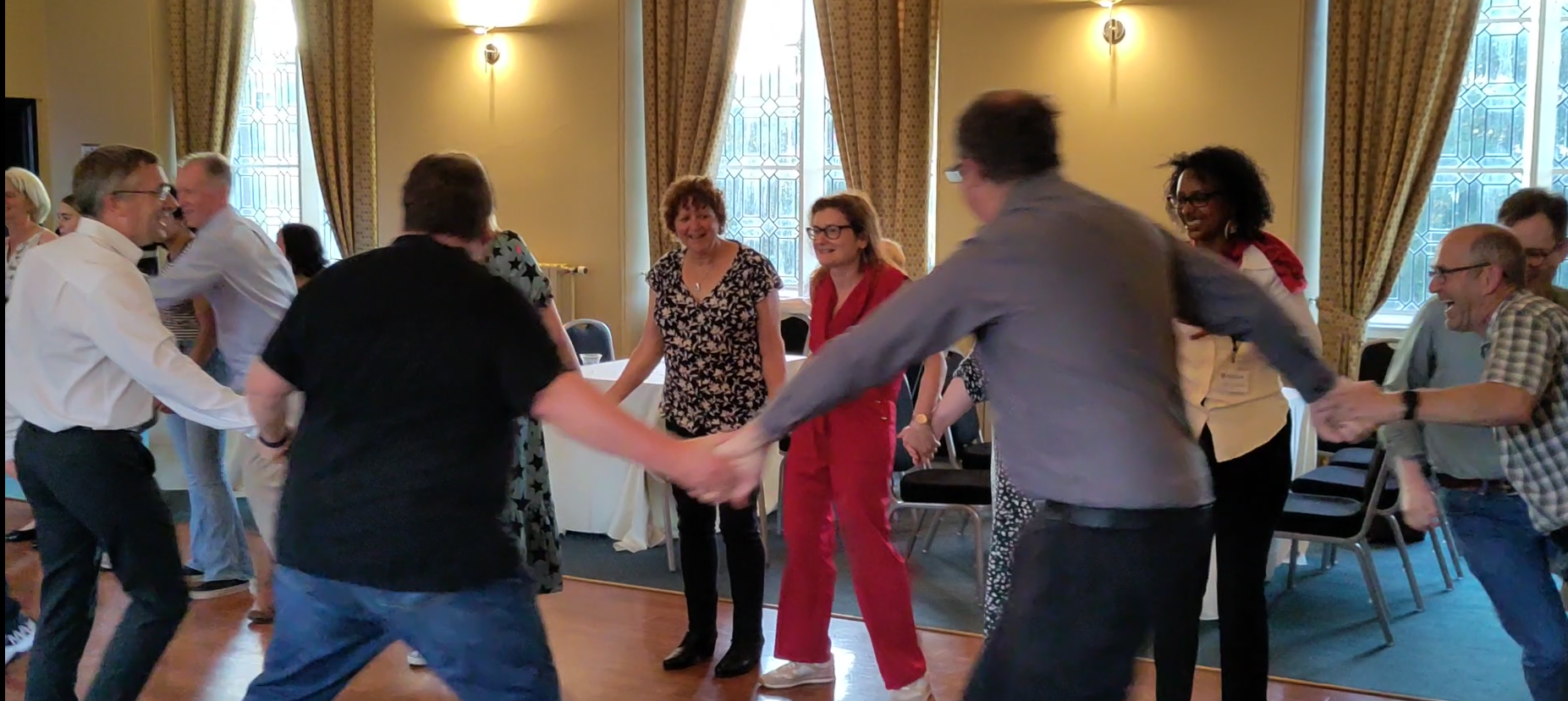
Overall, it was great to see ESLTIS starting up again after being laid low by the pandemic for a couple of years. It’s a vibrant community and I think we will continue to see it growing as a flagship event for those driving educational innovation and support in the sector. Oh, and *of course* there was a Ceilidh!


 Steve Cayzer